Medical Aesthetic Treatments for Darker Skin Tones in Montréal: Laser Hair Removal, Photorejuvenation, and Safe Pigmentation Treatment
Understand laser and light-based treatments for darker skin tones in Montreal:....
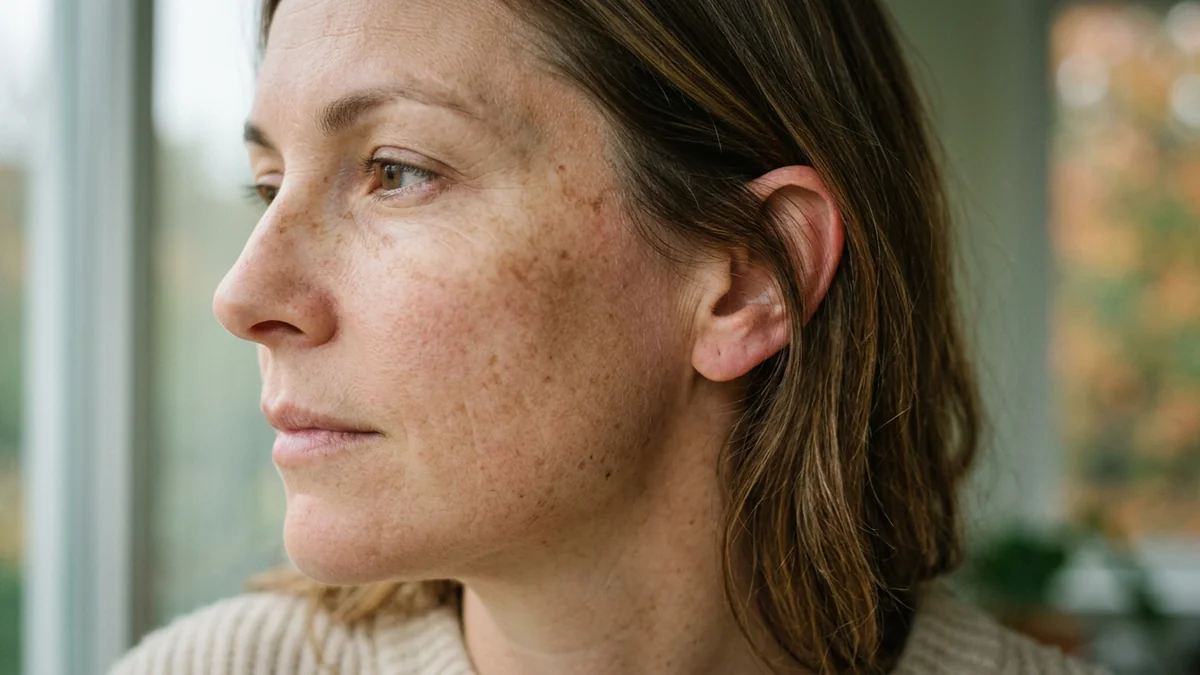
Read the postIn September, a lot of the people who drop by our clinic say the same thing: their brown spots have never looked so dark. It isn’t just an impression. After four months of a Montreal summer, the cheekbones, forehead and décolleté carry the cumulative mark of UV exposure, and the contrast with the rest of the complexion is at its peak. Paradoxically, it’s also the best time of year to do something about it.
Under the effect of ultraviolet rays, the pigment cells of the epidermis start producing more pigment7. That pigment, melanin, acts as a shield: the skin sends it to the surface to protect the nucleus of its cells. The problem is that over the years, this production stops being uniform and gathers into visible clusters.
UV rays act on the deeper structure at the same time. They generate unstable molecules, free radicals, which damage DNA and gradually break down the supporting tissue of the dermis5. This is what we call extrinsic aging, the kind that depends on the environment rather than on the age written into our genes. A sun spot, then, is never just a spot: it signals an area where the skin has taken a hit.
Because every serious protocol rests on one foundation: photoprotection. The international consensus published in 2025 on the management of hyperpigmentation stresses this point even before discussing devices, and reminds us that the choice of treatment depends on the type of pigmentation, its depth and the person’s phototype — in other words, their complexion and the way it reacts to the sun1. With melasma in particular, sun exposure is among the main causes of recurrence after a treatment2. In Montreal, the UV index drops sharply from the end of September onward: the window from October to March is when the sun no longer undoes, week after week, what has just been corrected.
Work carried out on human skin cells showed something else worth noting: intense pulsed light, applied after UVB irradiation, slowed down pigment production by the cells and calmed the inflammatory reaction triggered by UV rays7. In other words, these technologies don’t only act by erasing pigment that is already there; they also appear to calm the machinery that produces it.
That’s the question that comes up most often, usually after two or three brightening serums that didn’t do much. Creams and serums are indeed what people try first, but their limits are well documented: results take a very long time to appear, and consistency tends to fade along the way6. Chemical peels and laser or light-based treatments come next, in the hands of trained professionals6.
In practical terms, a serum mainly works by slowing the production of new pigment. A laser or intense pulsed light, on the other hand, goes after pigment that has already been deposited. These are two different levers, which is why they complement each other rather than replace one another.
Knowing whether certain spots call for an esthetic treatment depends entirely on what we’re looking at, and that’s exactly why an assessment comes before the session.
Classic solar lentigines — those well-defined spots on the face, neck and décolleté that settle in over successive summers — are among the pigmentations for which in-office procedures, chemical peels, lasers and intense pulsed light are considered, depending on the subtype and the depth of the pigment1. This is the territory of IPL photorejuvenation and the Hollywood Spectra.
The chemical peel works on the superficial layers of the epidermis, where pigment sits when it stays shallow; for that reason it appears alongside lasers and intense pulsed light among the options that come after creams, with the choice being made according to the subtype of pigmentation and the depth reached16. When the pigment has settled deeper, it’s the light-based technologies that go looking for it.
The brown marks left behind by acne that has stabilized are of another nature: this is post-inflammatory hyperpigmentation, a reaction of the skin to inflammation. The Clarity II laser and the Hollywood Spectra are among the technologies used for this type of pigment.
Melasma, for its part, calls for a careful read. These symmetrical patches, which often appear during or after a pregnancy, share several traits with skin that has seen a great deal of sun, right down to its deeper layers3. It’s also a form of pigmentation whose management is adjusted according to phototype, severity and the depth of the pigment1, and whose tendency to recur means that follow-up over time keeps its value2.
The spots you see today are the bill for the summer that has just ended, and the Montreal calendar works in your favour: the months when the sun keeps a low profile are the ones when the skin can be worked on without being immediately challenged again. Photoprotection remains the foundation of everything, even in January1. The rest — which technology, for what depth of pigment, at what pace — is decided by looking closely at the skin, something no serum bought at the pharmacy can do for you.
—
✍️ Article written by Edouard
Owner of Dermagyms, a medical aesthetic clinic in Montreal.
At Dermagyms, every treatment is personalized based on the skin analysis, the skin type and the client’s goals, under medical supervision.
⭐ 4.9★ on Google | 10+ years of experience
Book your free consultation, including an advanced skin analysis with the Observ 520x.
Understand laser and light-based treatments for darker skin tones in Montreal:....
Read the postWhy does post-pregnancy melasma persist? Discover what keeps these dark patches ....
Read the postThis article explains the differences between IPL and true laser technologies....
Read the postHave a question? Book your free consultation or call us directly!
 (514) 419-1144