Myths and Realities About Laser Hair Removal Unveiled
Laser hair removal has gained increasing popularity over the years. With this....
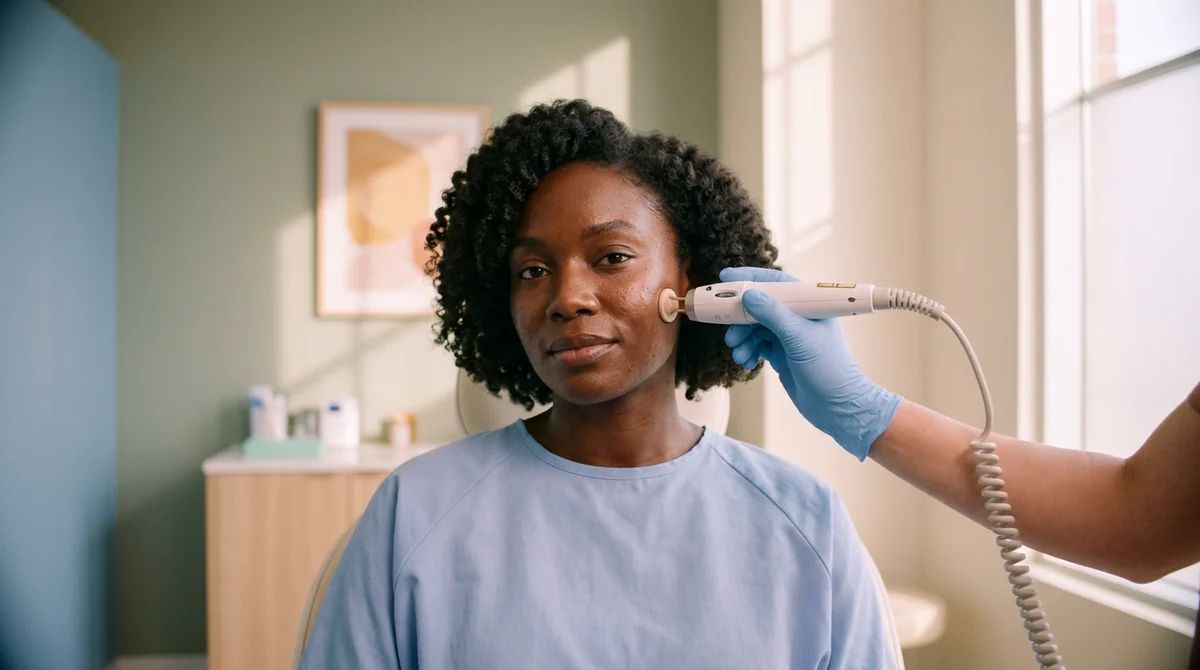
Read the postFor a long time, olive, brown, and dark skin tones were excluded from laser aesthetic clinics, out of fear of burns and pigmentation issues. That time is over. Recent platforms and a better understanding of selective photothermolysis have reshaped the field. In Montréal, where skin phototypes are constantly intersecting, this evolution concretely changes what I can offer to the people who walk through our door.
The principle of laser hair removal relies on melanin in the hair follicle as the target. The challenge is that melanin also resides in the epidermis, and in greater quantities in Fitzpatrick skin types IV to VI. If the laser cannot differentiate between the two, the energy heats the surface and can cause burns or pigmentation changes. Liew (2002) notes that proper patient selection and precise fluence adjustment to skin type remain the most important factors for an effective and well-tolerated laser treatment, and that the 1064 nm Nd:YAG, although less effective than other systems, remains better suited for higher phototypes.
Modern platforms have refined this logic. Gold et al. (2023) evaluated the safety and efficacy of a diode module combining three wavelengths (755, 810, and 1064 nm) in a single pulse. In 36 participants (46% Fitzpatrick types I-IV and 54% Fitzpatrick types V-VI), the average hair reduction three months after four sessions was 45.5% for types I-IV and 40.3% for types V-VI. No serious adverse events were reported. The authors conclude that efficacy is comparable for lighter and darker skin tones.
This is the question that comes up every week. Haedersdal and Haak (2011) state a useful truth: no current method promises permanent eradication. Solid evidence supports long-term reduction beyond six months after multiple sessions with alexandrite, diode, and long-pulse Nd:YAG lasers. Clinically, this translates to an initial protocol of six to ten sessions to bring a treatment area to a stable state, followed by less frequent maintenance sessions.
At Dermagyms, laser hair removal is among the services offered, and the choice of wavelength depends on the skin phototype and hair type assessed during the consultation.
IPL (intense pulsed light) uses, in the context of hair removal, a spectrum of 590 to 1200 nm (Haedersdal and Haak 2011). On lighter skin, IPL addresses several concerns simultaneously: sun spots, redness, and texture. On darker skin, the situation changes. The shorter wavelengths in the spectrum heat epidermal melanin, so the parameters require great caution. Certain very dark phototypes are better directed toward other modalities.
For photorejuvenation, we offer IPL at Dermagyms, but the treatment is recommended only after a thorough skin assessment, never by default. For higher phototypes, the approach may be redirected toward modalities that target melanin less, such as certain radiofrequency treatments.
This is a need frequently expressed by individuals with Fitzpatrick skin types IV to VI. Post-inflammatory hyperpigmentation, melasma, and sun spots behave differently on these skin tones. Tan et al. (2021), in their critical review of radiofrequency microneedling, highlight that this technology can be used repeatedly and safely in combination with other modalities, including in individuals with darker phototypes. They also note that dermal remodeling and collagen production continue to improve for up to six months after sessions.
This finding is valuable: on darker skin, technologies that bypass melanin as a target — microneedling foremost among them — often become a better entry point than conventional pigment lasers for addressing spots, texture, and certain post-inflammatory irregularities.
In Québec, aesthetic laser procedures are regulated. At Dermagyms, the assessment is performed by our team of qualified professionals, under medical supervision, in order to determine what is appropriate for the individual’s phototype, pigmentation history, and expectations. The technology is then selected based on this analysis.
The notion that one must “wait for winter” to undergo laser treatment is not wrong, but it is incomplete. The true parameter is not the calendar, but actual sun exposure in the weeks surrounding the sessions. On darker skin, strict adherence to high-SPF sunscreen and direct sun avoidance becomes critical to prevent transient hyperpigmentation from developing after a session.
Darker skin tones are no longer a contraindication to light-based and laser treatments. They have become a context in which the choice of technology, the parameters, and the rigor of oversight make the difference between a great result and an avoidable complication. That is precisely what the consultation is for — to determine the right course before the first session.
—
✍️ Article written by Edouard
Owner of Dermagyms, medical aesthetic clinic in Montreal.
At Dermagyms, every treatment is personalized based on a detailed skin analysis, your skin type, and your goals, under medical supervision.
⭐ 4.9★ on Google | 10+ years of experience
Book your free consultation, including an advanced skin analysis with Observ 520x.
Laser hair removal has gained increasing popularity over the years. With this....
Read the postLaser hair removal is the most popular treatment for permanent hair removal.....
Read the postDiscover the causes, risks and effective solutions for treating pigmentation....
Read the postHave a question? Book your free consultation or call us directly!
 (514) 419-1144