Acne or Rosacea: How to Tell Pimples from True Persistent Redness
Acne or rosacea? Learn how to tell breakouts, persistent redness and visible....
Read the postAfter 40, skin changes at a deep level. Collagen production slows, the skin barrier changes, and the epidermis no longer has the same quality it had at 25. Creams quickly reach their ceiling: they work on the surface while everything plays out deeper down, in the dermis. That is why aesthetic professionals today rely on a winning trio: advanced imaging, energy-based technologies, and injection techniques capable of reaching the deeper layers. A personalized assessment remains the best starting point for knowing when your cosmetic routine has done all it can.
Before discussing treatments, let’s set the scene. The skin is a layered organ, with an external barrier (the stratum corneum) whose composition and structure determine skin permeability. Wertz (2013) notes in a review on skin biochemistry that this epidermal barrier relies primarily on stratum corneum lipids, whose organization determines the skin’s permeability barrier. Over time, this organized structure breaks down and the barrier becomes less effective.
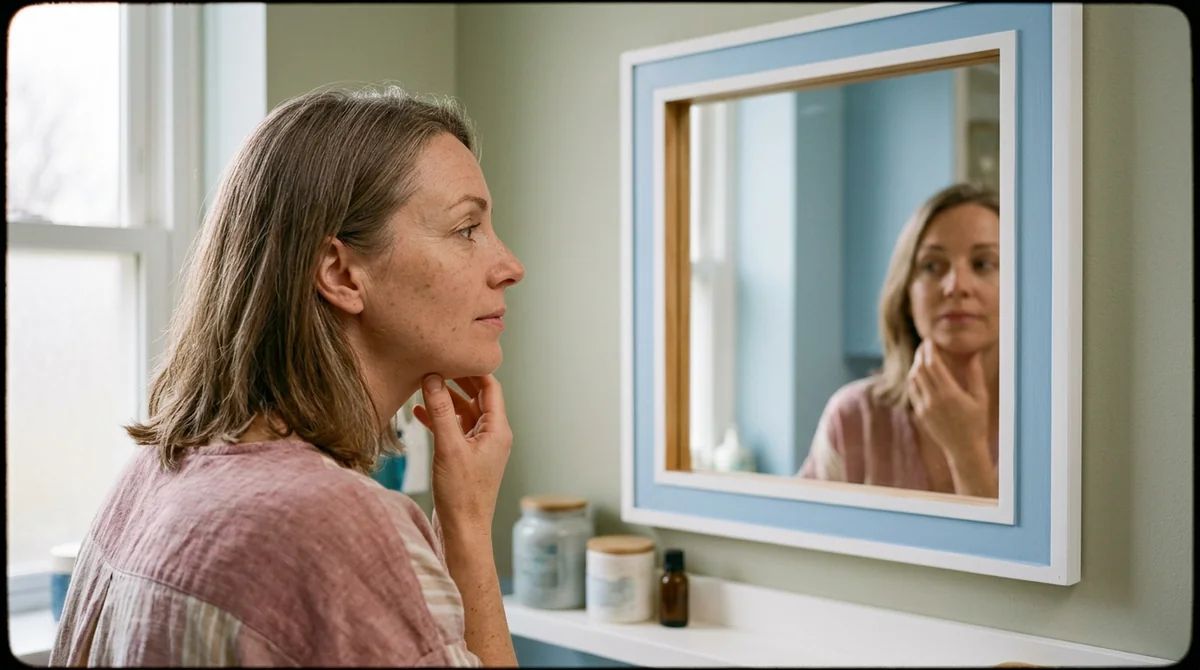
At the same time, skin gradually loses elasticity and thickness: collagen and elastin production declines, cell turnover slows, and the cumulative effects of sun damage (photoaging) come to the surface. This is what the mirror shows us around age 40–45: skin that marks more easily, recovers more slowly, and creases differently.
Deeper still, the dermis is a true workshop where fibroblasts and the extracellular matrix are in constant dialogue. When this conversation falters, firmness follows the same path.
A cream acts primarily on the superficial layers. After 40, however, the challenge shifts deeper: it becomes necessary to stimulate dermal fibroblasts, rebuild the matrix, and restore the skin’s architecture. This is nearly impossible for a topical product alone, since the stratum corneum described by Wertz (2013) is specifically designed to prevent molecules from penetrating.
This is why aesthetic clinics rely on technologies that bypass or modify this barrier in a controlled way: radiofrequency, microneedling, intense pulsed light, or chemical peels. The goal is not to throw away your favorite cream, but to add a lever that cosmetics simply cannot engage.
Before intervening, you need to see clearly. Cappilli et al. (2024) published a systematic review on line-field confocal optical coherence tomography (LC-OCT), a technology that produces a “virtual biopsy” of the skin without cutting it. The authors conclude that the applications of LC-OCT are expanding beyond tumor diagnosis into cosmetic procedures and the monitoring of non-invasive therapies.
At Dermagyms, skin analysis is performed using the Observ 520x, a multispectral imaging system that reveals what the eye cannot see: subcutaneous sun damage, vascularization, and deep texture. This reading guides the choice of treatment, rather than navigating blindly.
After 40, a comprehensive approach relies on three complementary families of action.
1. Dermal stimulation. Microneedling with devices such as the Twist Xcellarispro, or radiofrequency microneedling with devices such as the Potenza, trigger a repair process in the dermis by creating controlled micro-injuries. These are the most direct approaches for reworking the firmness and texture that diminish with age.
2. Targeted muscle relaxation. Expression wrinkles on the forehead, crow’s feet, and glabellar lines deepen because muscle contractions leave their mark on less elastic skin. Botox, administered by a physician or a nurse under medical delegation (in accordance with the Collège des médecins du Québec), works by relaxing muscle contractions. A thorough knowledge of muscular anatomy is essential here, particularly for the forehead and glabella: precise placement is required to prevent the product from diffusing toward the eyelid, which could cause temporary ptosis.
3. Surface quality restoration. Photorejuvenation IPL, HydraFacial, chemical peels, Hollywood Spectra: these approaches rework texture, radiance, and pigmentation — in other words, everything that resists even the most sophisticated evening cream.
A question that comes up often during consultations. There is no universal age. The degradation of the skin’s permeability barrier (Wertz 2013) and the progressive loss of firmness and radiance are part of cutaneous aging. Beginning a care regimen around the age of forty allows these changes to be managed gradually, rather than trying to catch up a decade later.
Beyond current skin evaluation technologies, another shift is emerging: artificial intelligence applied to skin. Yan et al. (2025) presented PanDerm, a vision model pre-trained on more than 2 million skin images, which improves skin cancer screening accuracy by 11% in dermoscopy and differential diagnosis by non-dermatologist healthcare professionals by 16.5% on clinical photographs. These tools are not intended to replace the professional, but they point toward a trend of increasingly precise skin analysis, with some applications that may gradually make their way into aesthetic medicine.
After 40, caring for your skin goes beyond the question of which product to use: it is an ecosystem. Understanding what changes, accurately assessing what you have, and combining the right interventions at the right time. Creams still have their place, but they become one piece of the puzzle, not the complete picture. This is precisely the shift we support at Dermagyms: moving from an isolated cosmetic routine to a structured, measured approach tailored to the skin you actually have.
—
✍️ Article written by Edouard
Owner of Dermagyms, medical aesthetic clinic in Montreal.
At Dermagyms, every treatment is personalized based on a detailed skin analysis, your skin type, and your goals, under medical supervision.
⭐ 4.9★ on Google | 10+ years of experience
Book your free consultation, including an advanced skin analysis with Observ 520x.
Acne or rosacea? Learn how to tell breakouts, persistent redness and visible....
Read the postThis article explains the differences between IPL and true laser technologies....
Read the postWhy does post-pregnancy melasma persist? Discover what keeps these dark patches ....
Read the postHave a question? Book your free consultation or call us directly!
 (514) 419-1144