Body Microneedling in Montreal: the 2026 trend for improving skin texture
Body microneedling in Montreal using RF technology helps improve skin texture,....
Read the postKey takeaways: Rosacea manifests as persistent redness and small dilated vessels on the face. Photorejuvenation by intense pulsed light (IPL) targets hemoglobin to eliminate these visible signs. A meta-analysis by Zhai et al. (2024) confirms its efficacy, with a slight advantage over PDL laser for improvements greater than 75%. At Dermagyms, IPL photorejuvenation is among the options offered to reduce redness associated with rosacea.
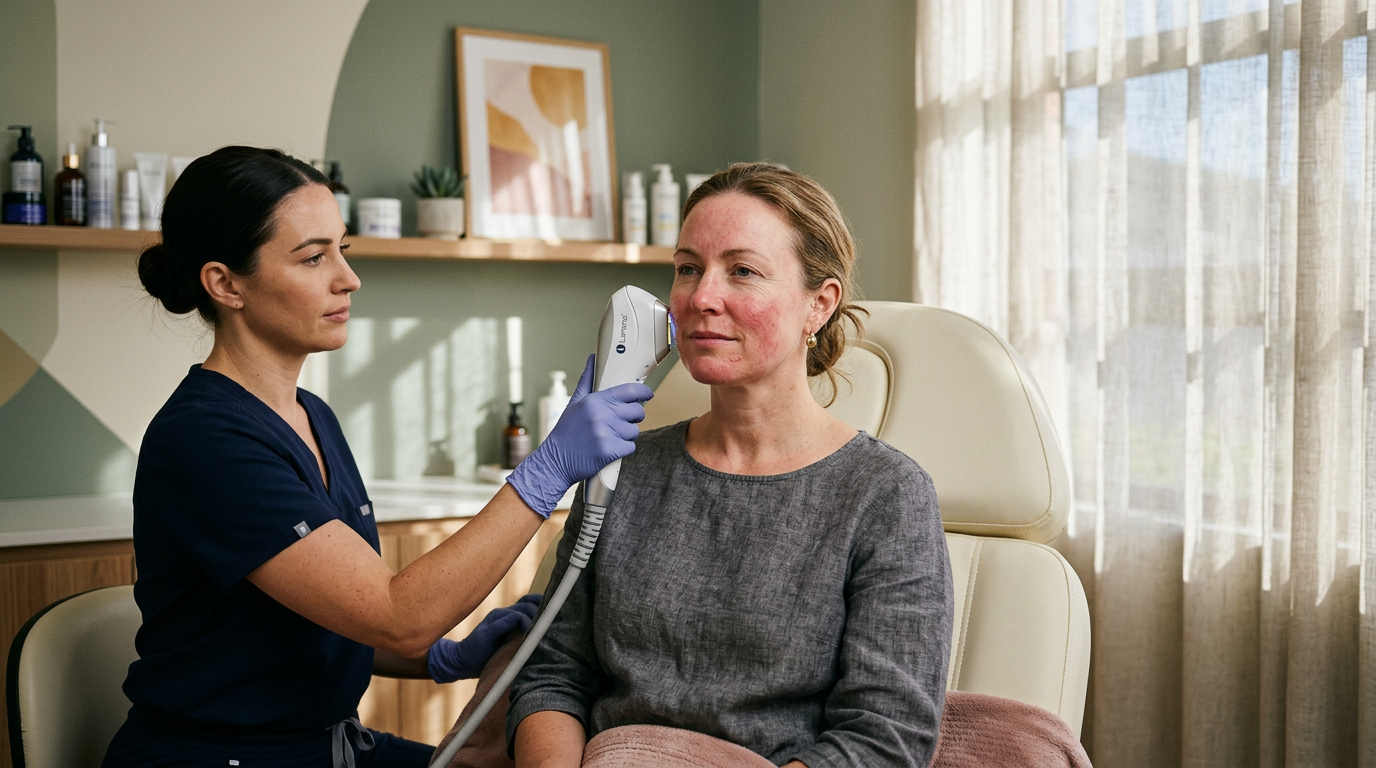
Rosacea appears mainly on the cheeks, nose, chin, and forehead. It often begins with simple, fleeting hot flashes before settling into permanent redness (erythema), sometimes accompanied by telangiectasias — those small vessels that trace their network right at the surface of the skin. Many people walk through our door in the spring, precisely because the transition from Montreal’s winter to the first rays of May puts the skin to a serious test.
IPL and vascular lasers are based on the same elegant principle: emitting light that is specifically absorbed by hemoglobin found in dilated vessels. The energy heats the vessel until it coagulates (selective photothermolysis), then it gradually fades. The surrounding tissue is largely spared, because the wavelength is calibrated to target the red color of blood.
IPL (intense pulsed light) emits a broad spectrum of wavelengths, which allows it to address both diffuse redness and certain pigmented spots. The pulsed dye laser (PDL), often mentioned in the same discussion, is monochromatic and highly specific to hemoglobin.
The meta-analysis by Zhai et al. (2024), published in the Journal of Cosmetic Dermatology, compared these two approaches head-to-head in 141 people. No significant difference appeared between IPL and PDL for crossing the 50% improvement threshold, but IPL gained a slight edge at the 75% threshold. PDL, on the other hand, is considered more comfortable during the session.
Erythematotelangiectatic rosacea, characterized by persistent redness and visible small vessels, is the form that responds best to these treatments. A study by Tang and He (2025) compared three modalities in 112 people: PDL, narrow-band IPL (NB-IPL), and broad-band IPL (BB-IPL). Verdict: NB-IPL reduces erythema more markedly, while PDL maintains a strong balance between efficacy and safety.
In practice, the choice of technology and its parameters depends on skin type, the predominance of redness or telangiectasias, and each person’s sensitivity. All of this is discussed during the initial consultation at Dermagyms.
In Quebec, using laser or intense pulsed light devices for a condition like rosacea requires a professional and safe framework. The guidelines of the Collège des médecins du Québec (CMQ) emphasize that a skin condition warrants rigorous evaluation. At Dermagyms, IPL photorejuvenation is offered within this framework, with a prior aesthetic evaluation carried out by a qualified professional on the team.
The German guidelines of the Dermatology Society (Paasch et al., 2022) also list rosacea among the validated indications for laser and IPL therapy. This rigorous framework is the key to a treatment that is both safe and effective.
A complete protocol generally spans 3 to 6 sessions spaced 3 to 4 weeks apart. This interval allows the skin time to clear the coagulated vessels and for redness to fade. Since rosacea is a chronic condition, maintenance sessions may be planned to sustain results. Triggers (heat, alcohol, spices, stress) don’t disappear by magic, but the skin reacts to them much less strongly.
Interestingly, Toyos et al. (2022) showed in a randomized study that IPL can also relieve signs of dry eye disease related to meibomian gland dysfunction, a condition often associated with rosacea. This ocular aspect, however, falls under a specific medical protocol carried out by vision care professionals, and remains clearly distinct from aesthetic photorejuvenation.
In Montreal, sun exposure remains moderate and temperatures are mild: the skin is less stressed, and managing photosensitivity after a session becomes simpler. This is an ideal window to start a series of sessions, provided that serious sun protection is applied between appointments.
Rosacea is not inevitable. IPL photorejuvenation offers a documented and effective solution for reducing persistent redness and telangiectasias. Recent data (Zhai et al., 2024; Tang & He, 2025) confirm its performance. At Dermagyms, IPL is offered in a safe framework, following a consultation that adjusts the parameters to your skin type and the aesthetic signs observed.
Body microneedling in Montreal using RF technology helps improve skin texture,....
Read the postThis article explains the differences between IPL and true laser technologies....
Read the postCoolSculpting is a cryolipolysis technique (fat destruction by cold) that....
Read the postHave a question? Book your free consultation or call us directly!
 (514) 419-1144